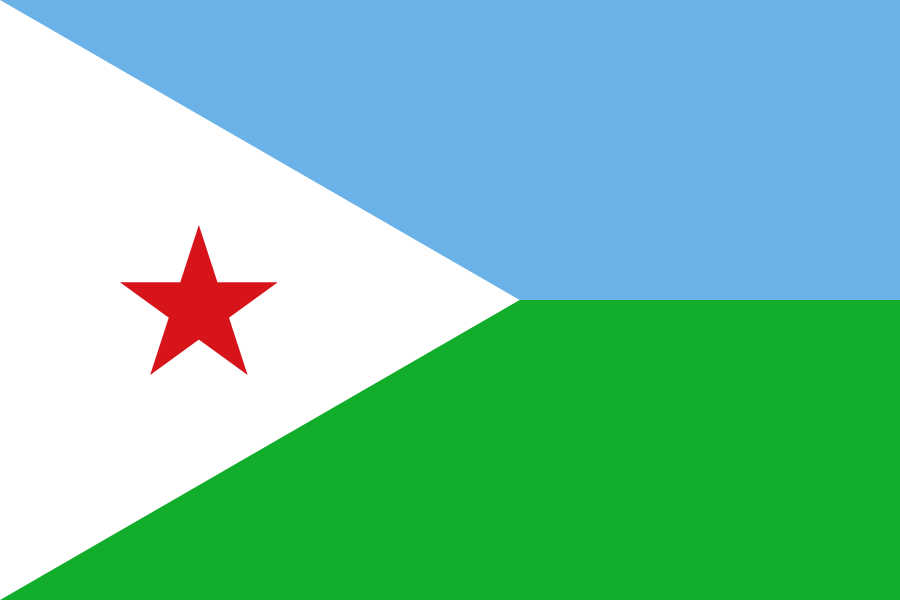
Overview
Djibouti operates a mixed legal system within a presidential republic. Its written constitution stands as the supreme instrument of the legal order, prevailing over all ordinary legislation. This profile sets out, in structured form, how Djibouti’s sources of law, constitution, courts, fundamental rights, regional commitments and avenues for assistance are organised.
Legal system & tradition
Djibouti has a mixed legal system, combining elements of more than one tradition — commonly civil or common law together with religious or customary law. Different bodies of law govern different subjects: codified or common-law rules often regulate commercial and civil matters, while religious or customary norms may govern personal status, family and land. The applicable source therefore depends on the subject matter and, at times, on the parties involved, with Supreme Court at the head of the judiciary. Its sources of law draw on more than one tradition, combining constitutional and statutory law with religious or customary rules according to the subject.
Constitution & government
Djibouti’s constitution is the supreme law of the land. It defines the structure of the state distributes power among the principal organs of government, and entrenches the fundamental rights and duties of individuals. All other legislation and executive action must conform to it, and a dedicated constitutional court or council reviews legislation for conformity with it.
Courts & disputes
Judicial authority in Djibouti is exercised through a tiered court system. Matters are generally heard first by courts of first instance, whose decisions may be challenged before appellate courts, with Supreme Court exercising final jurisdiction over the questions within its competence. Specialised courts or tribunals may handle constitutional, administrative, commercial, labour or family matters, depending on the subject.
Major branches of law
Rights & rule of law
Fundamental rights and freedoms in Djibouti are guaranteed principally by the constitution and by legislation, and, where applicable, by the regional and international human-rights instruments the state has accepted. Their protection in practice depends on enforcement by independent courts and oversight bodies, and the precise catalogue, scope and available remedies vary by area of law. As a member of the African Union, Djibouti falls within the framework of the African Charter on Human and Peoples’ Rights, overseen by the African Commission and African Court.
Key milestones
Higher-risk & getting help
This profile provides general legal orientation and is not a substitute for professional advice. For a specific matter or dispute in Djibouti, a lawyer qualified in the relevant jurisdiction should be consulted. Where they exist, legal-aid schemes, bar associations and official government services can help identify the appropriate forum and representation; in urgent situations affecting personal safety, local emergency services should be contacted first.
Official sources
About this profile
JusticeWiki profiles provide general legal orientation, not legal advice. Each section is reviewed and dated, and cites official sources so you can check the original. Found an error? Email us a correction and a reviewer will check it.